Learning does not have to be limited to textbooks, lectures, tests, and memorization. In a world where learners are constantly surrounded by interactive apps, games, challenges, and digital experiences, education is also evolving. This is where learning gamification comes into play. But what is learning gamification? In simple terms, it means using selected game-like elements in a learning environment to make education more engaging and interactive. Instead of turning every lesson into an actual game, gamification transforms the learning experience by introducing elements such as points, badges, levels, challenges, progress bars, rewards, and friendly competition. The goal is not simply to make learning “fun.” Effective gamification encourages learners to participate actively, track their progress, overcome challenges, and stay engaged with the learning process.
What Is Learning Gamification?
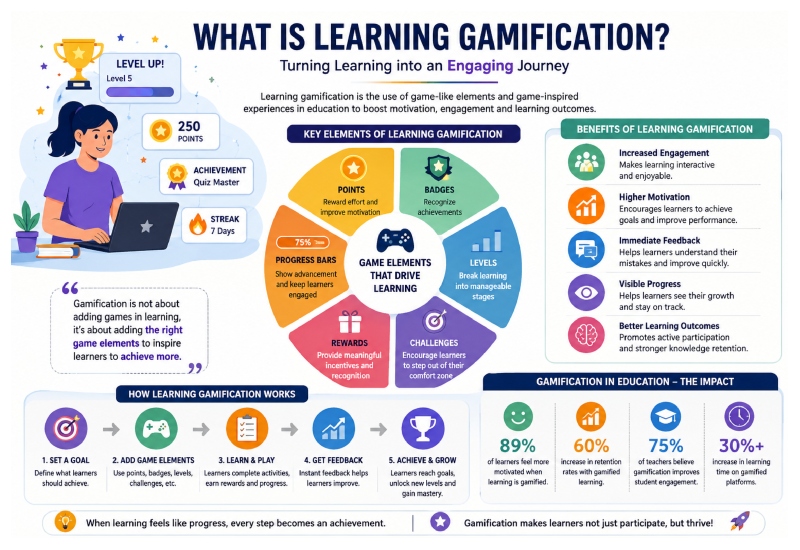
Learning gamification is the use of game-like elements in education or training to encourage motivation, participation, and continuous learning. For example, imagine a mathematics platform where students earn points for completing practice questions. They can unlock new levels, earn badges, track their progress, and take part in optional challenges with classmates. The mathematics itself has not changed. What has changed is **how the learner experiences the learning process. Gamification does not mean replacing education with video games. Instead, it adds carefully selected game elements to an existing learning experience.
Why Is Learning Gamification Becoming Popular?
Maintaining learner attention can be challenging, especially when educational content requires learners to process large amounts of information. Gamification introduces a different dynamic. Instead of asking learners simply to “finish the lesson,” a gamified experience can encourage them to:
- Complete a challenge
- Reach the next level
- Improve their score
- Earn a badge
- Maintain a learning streak
- Unlock new content
- Beat their previous performance
- Receive immediate feedback
These small milestones can create a sense of progress. When learners can clearly see what they have accomplished and what remains ahead, a large learning goal can feel much more manageable.
How Does Learning Gamification Work?
A gamification strategy can combine several elements rather than relying on a single reward.
1.Points
Points give learners immediate feedback on their progress and performance. For example, a learner might receive 10 points for completing an activity and additional points for answering questions correctly. Points can answer a simple psychological question:
“How am I doing?”
2.Badges
Badges recognize specific achievements or milestones. A learner might earn badges such as:
- First Lesson Completed
- Mathematics Master
- 7-Day Learning Streak
- Problem-Solving Champion
- Perfect Score
Badges can give learners visible evidence of their accomplishments.
3.Levels
Levels divide a larger learning journey into smaller stages. Instead of seeing a course as one enormous task, learners can progress from Beginner to Intermediate and eventually Advanced. This gives learners a clear sense of progression:
Start → Practice → Improve → Unlock → Master
4.Challenges
Challenges turn learning activities into clear and achievable goals. Rather than simply presenting 20 questions, a platform might introduce a challenge such as:
> “Can you crack 10 problems correctly in under 5 minutes?”
The content remains educational, but the learner now has a clear objective.
5.Progress Bars
A progress bar gives learners a clear visual snapshot of their journey, showing both how much they have completed and what remains. Seeing 75% completed can encourage a learner to finish the remaining 25%. This is particularly useful for online courses, professional training, and self-paced education.
6.Rewards
Rewards can provide an additional incentive for learners to continue participating. They do not always need to be physical or financial. A reward could be:
- A digital badge
- Access to advanced content
- A certificate
- A new avatar
- Bonus points
- Recognition
- Unlockable features
The best reward systems support learning rather than distracting learners from it.
Learning Gamification vs. Game-Based Learning
These concepts are often confused, but they are not identical. Gamification incorporates game-like elements into the learning process. Game-based learning uses an actual game as the learning environment. For example, giving students points and badges for completing a science course is gamification. Playing an educational simulation where students manage a virtual ecosystem is game-based learning. The difference can be summarized simply:
- Gamification = learning + game elements
- Game-based learning = learning through a game
Understanding this difference helps educators choose the right approach for their objectives.
Real-World Examples of Learning Gamification
Gamification can be used across almost every educational environment.
Schools
Teachers can introduce points, achievement badges, team challenges, quizzes, and progress-tracking systems in the classroom. For example, students could earn points for completing assignments on time and additional achievements for helping classmates or solving difficult problems.
Universities
Higher education institutions can use gamified quizzes, interactive assignments, achievement systems, and course challenges to encourage participation.
Corporate Training
Businesses can turn employee training into structured and engaging learning journeys. Employees might complete modules, collect certificates, achieve milestones, and unlock advanced training.
Online Learning Platforms
Digital education platforms are particularly suitable for gamification because software can automatically track progress, scores, achievements, and learning streaks.
Professional Development
Professionals can use gamified learning systems to maintain continuous development and make certification pathways easier to follow.
What Makes Gamification Effective?
Simply adding points and badges does not automatically create effective learning. The real strength of gamification comes from purposeful design. A well-designed system should connect game mechanics with educational objectives.For example:
- Learning objective: Improve vocabulary
- Gamification element: Daily vocabulary challenge
- Feedback: Instant score
- Progress: Vocabulary mastery level
- Achievement: Vocabulary Champion badge
Here, the game elements support the learning objective rather than becoming distractions.
The Psychology Behind Gamified Learning
One reason gamification can be powerful is that it gives learners frequent feedback. Traditional learning may sometimes provide feedback only after an assignment, quiz, or examination. Gamified systems can provide feedback almost immediately. A learner answers a question.
Correct → progress increases.
Incorrect → feedback appears → another attempt.
This creates a continuous learning loop:
Attempt → Feedback → Adjustment → Improvement → Achievement
The learner becomes an active participant instead of simply waiting for an evaluation.
Benefits of Learning Gamification
When thoughtfully implemented, gamification can provide several benefits.
Increased Engagement
Interactive challenges can encourage learners to spend more time participating in learning activities.
Greater Motivation
Clear goals, milestones, and achievements can give learners additional reasons to continue.
Immediate Feedback
Learners can quickly understand what they did correctly and where improvement is needed.
Visible Progress
Progress indicators make long-term learning goals easier to understand.
Active Participation
Gamification can shift learners from passive consumption toward active problem-solving and decision-making.
Personalized Learning Experiences
Digital gamification systems can potentially adapt challenges and learning paths according to learner performance.
Stronger Learning Habits
Features such as streaks, daily challenges, and recurring goals can encourage consistent participation.
Can Gamification Improve Learning?
Yes—but gamification is not a magic button. Its effectiveness depends on how it is designed and implemented. If an educational platform focuses only on competition, learners may become more interested in winning than understanding. If rewards are poorly designed, students may complete activities merely to collect points. Therefore, the central question should not be:
“How can we make learning more like a game?”
A better question is:
“Which game elements can help learners achieve this particular educational goal?”
That shift in thinking separates meaningful gamification from superficial gamification.
Common Mistakes in Learning Gamification
Using Too Many Rewards
If everything produces a badge or points, achievements can quickly lose their meaning.
Focusing Only on Competition
Leaderboards can motivate some learners but discourage others.
Ignoring Educational Objectives
Gamification should support the lesson, not become the lesson.
Making the System Complicated
Learners should understand how the system works without needing instructions longer than the actual lesson.
Rewarding Activity Instead of Learning
Completing many tasks does not necessarily mean understanding the material.
A strong system rewards meaningful progress.
How to Gamify a Learning Experience
Creating a gamified learning experience can begin with five simple steps.
Step 1: Define the learning objective.
Decide exactly what learners should know or be able to do.
Step 2: Identify the desired behavior.
Do you want learners to practice more, complete assignments, collaborate, revise material, or solve problems?
Step 3: Select suitable game mechanics.
Choose points, badges, levels, challenges, progress bars, rewards, or other elements that support the desired behavior.
Step 4: Provide immediate feedback.
Let learners understand their performance and how they can improve.
Step 5: Measure the outcome.
Evaluate whether gamification actually improved participation, completion, knowledge, or performance.
The Future of Learning Gamification
The future of gamified learning is moving beyond simple points and leaderboards. Artificial intelligence, adaptive learning, interactive simulations, virtual environments, and personalized learning systems can make gamified education increasingly responsive to individual learners.
Imagine a learning platform that recognizes when a student is struggling with a particular concept and automatically introduces easier practice challenges. Once the learner improves, the system gradually increases difficulty. That is more than a collection of badges. It is a learning experience designed around **progress, feedback, challenge, and personalization.
FAQs
- What is learning gamification?
Learning gamification is the use of game-like elements such as points, badges, levels, challenges, rewards, and progress bars in education to make learning more engaging, interactive, and motivating.
- What is an example of learning gamification?
A common example is an online course where learners earn points for completing lessons, receive badges for reaching milestones, and unlock new levels after passing quizzes or completing challenges.
- What is the difference between gamification and game-based learning?
Gamification adds selected game elements to an existing learning experience, while game-based learning uses an actual game to teach a concept or skill. In simple terms, gamification adds game mechanics to learning, whereas game-based learning uses a game as the learning environment.
- What are the benefits of learning gamification?
Learning gamification can increase engagement, encourage motivation, provide immediate feedback, make progress visible, and promote active participation. When properly designed, it can make the learning journey more interactive and rewarding.
- Can learning gamification be used for adults and professional training?
Yes. Gamification is not limited to children or schools. It can be used in universities, online courses, employee training, professional development, and corporate learning to encourage participation and continuous skill development.
Final Thoughts
So, what is learning gamification?
It is the thoughtful use of game-inspired mechanics and experiences to make learning more engaging, motivating, interactive, and measurable.
The strongest gamification strategies do not try to turn education into entertainment. They use the psychology and structure of games—goals, challenges, feedback, progress, achievement, and meaningful rewards—to help learners stay involved in the learning journey.
When designed correctly, gamification can transform the question from:
“Do I have to complete this lesson?”
into:
“Can I reach the next level?”
And sometimes, that small change in mindset can make a surprisingly big difference in how people learn.