
My Journey to Finding the Best Platform
Last Friday evening, I sat down with a cup of coffee, opened my laptop, and thought, “This won’t take long.” All I wanted was to find the perfect websites for ticket sale GamificationSummit — a platform to sell tickets to a Gamification Summit. Simple, right?
I typed “websites for ticket sale GamificationSummit” into Google and pressed Enter. Within seconds, my screen was filled with countless ticketing platforms. Every website claimed to be the best. One promised higher ticket sales, another advertised the lowest fees, a third claimed the fastest checkout process. Some looked incredibly professional. Others felt outdated the moment I landed on their homepage.
I opened the first website. Then the second. Then the third. Before I realized it, more than twenty browser tabs were staring back at me. Instead of finding the answer, I had created an even bigger question: which one should I actually trust?
That moment reminded me of something many event organizers experience. Planning a Gamification Summit is exciting. Choosing the website that will sell your tickets? That’s where the real challenge begins.
If you’ve landed here because you’re searching for websites for ticket sale GamificationSummit, you’re probably standing exactly where I was — surrounded by endless choices, unsure which platform deserves your time, money, and trust. So instead of giving you another generic list, let me walk you through what I actually found, including real platforms, real pricing, and the lessons that changed how I evaluate these tools.
The First Website Looked Amazing… Until I Tried Buying a Ticket
I’ll admit it — the homepage impressed me. Beautiful colors, modern design, large headlines, professional animations. It looked exactly like the kind of platform I wanted. For a moment I thought, “Perfect, my search is already over.” Then I clicked “Buy Ticket,” and everything changed.
The registration form seemed endless: name, email, phone number, company, job title, country, industry, LinkedIn profile, dietary preference, emergency contact. I paused and wondered, “Am I registering for an event or applying for a government job?”
That single experience taught me something I won’t forget: people love buying tickets, but they hate filling out forms. Every unnecessary question gives visitors another reason to leave. Imagine spending thousands of dollars promoting your summit only to lose attendees because your registration process feels like homework. That’s painful, and it’s more common than most organizers realize.
The Second Website Was Faster… But Something Still Felt Wrong
The next platform loaded almost instantly. Registration took less than a minute. Everything looked clean, simple, fast — exactly what I wanted. Then I reached the payment page, and something felt off. There were no familiar trust badges, no security indicators, no clear refund information, no explanation of payment protection.
I stopped. If I felt uncertain, how would a first-time attendee feel? Online ticket sales depend on one thing more than anything else: trust. People don’t just buy tickets, they buy confidence. If your checkout page doesn’t feel secure, visitors won’t risk entering their payment details — they’ll simply close the tab and keep scrolling, and you’ll never even know they were there.
The Website Wasn’t Selling Tickets. The Experience Was.
This realization changed how I looked at every ticketing platform after that. Before this search, I believed websites existed only to process payments. I was wrong. Every ticket-selling website creates an experience. The loading speed shapes the first impression. The registration form tests patience. The checkout page builds or breaks trust. The confirmation email creates excitement. Even small details matter — a slow-loading page, a confusing button, a missing image, an unexpected fee. Any one of these can quietly reduce your ticket sales.
Most organizers blame marketing when registrations are low. Sometimes the real problem is much simpler: the website itself is pushing people away.
Comparing the Real Websites for Ticket Sale GamificationSummit
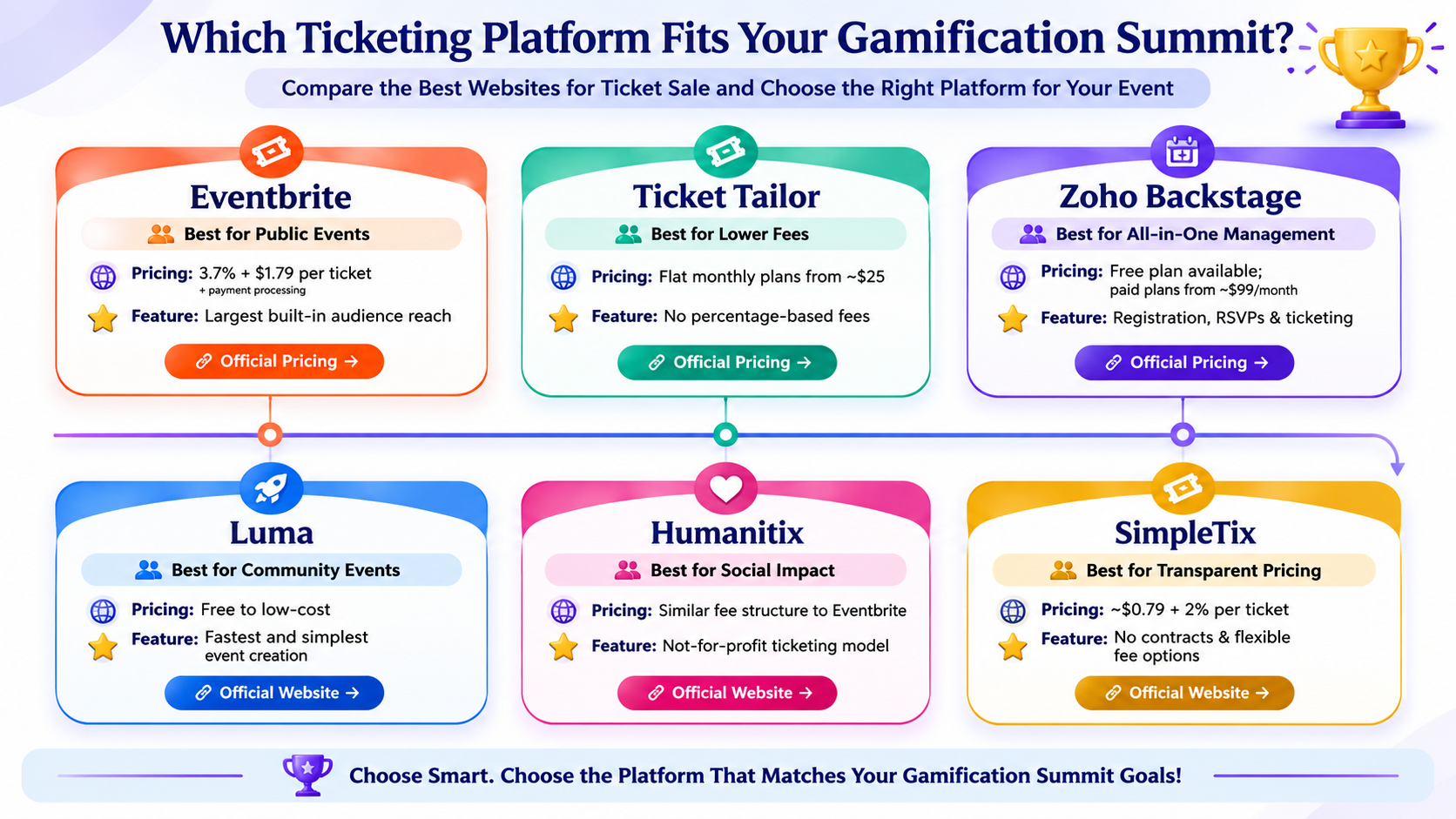
Once I stopped chasing flashy homepages, I compared the platforms event organizers actually rely on in 2026. Here’s an honest breakdown based on current pricing and features:
| Platform | Best For | Pricing Model | Notable Feature |
|---|---|---|---|
| Eventbrite | Public events needing marketplace discovery | ~3.7% + $1.79/ticket + 2.9% processing | Largest built-in audience reach |
| Ticket Tailor | Organizers who want low fees and white-label branding | Flat monthly plans from ~$25, no commission | No percentage-based fees |
| Zoho Backstage | Small businesses wanting ticketing bundled with event management | Free plan available; paid plans from ~$99/month | Registration, RSVPs, and ticketing in one place |
| Luma | Community meetups and informal summits | Free to low-cost, simple setup | Fastest, simplest event creation |
| Humanitix | Organizers who want fees reinvested into social causes | Similar fee structure to Eventbrite | Not-for-profit fee model |
| SimpleTix | Organizers who want transparent, low flat fees | ~$0.79 + 2%/ticket, no subscription | No contracts, fees can be passed to buyer or absorbed |
Pricing on these platforms changes fairly often and can vary by region, so always confirm current rates on the provider’s own pricing page before committing. For a Gamification Summit specifically, the right pick usually comes down to two questions: do you need Eventbrite-style public discovery to reach new attendees, or do you already have an audience (through gaming communities, LinkedIn, or partner networks) and just need a low-fee, well-branded checkout? If you’re still unsure, read our guide on choosing the right ticketing platform for your Gamification Summit. Most summits with an existing community lean toward Ticket Tailor, Zoho Backstage, or Luma. Public, discovery-driven summits often do better on Eventbrite or Humanitix.
I Started Looking Beyond Fancy Features
The more platforms I explored, the more I noticed something interesting: many competed by listing hundreds of features — analytics, CRM integrations, automation, advanced reports, custom widgets, AI recommendations, marketing dashboards. The list seemed endless, and at first I thought more features must mean a better platform. Not necessarily.
If attendees can’t buy a ticket within two minutes, most of those extra features don’t matter. I stopped looking for the platform with the longest feature list and started asking simpler questions: Would my parents understand this website? Would someone using their phone complete the registration easily? Would I personally enjoy buying a ticket here? Those questions helped more than any comparison chart.
The Features That Actually Matter
A Fast registration process. Nobody visits a ticket page hoping to spend ten minutes filling out forms. Visitors want to buy the ticket, get confirmation, and move on. The easier that journey, the more registrations you’ll get.
Mobile-friendly design. Think about how often you discover events on your phone — probably every week. Now imagine clicking an ad only to find tiny text and broken buttons. You’d leave immediately. So will your attendees.
Multiple payment options. Some people prefer credit cards, others digital wallets or local payment gateways. The more convenient payment becomes, the fewer sales you’ll lose.If you’re also comparing payment methods, explore our guide to the best payment gateways for Gamification Summit ticket sales before choosing your ticketing platform.
Automatic confirmation emails. Imagine buying a ticket, watching the money leave your account, and getting nothing back — no email, no receipt, no confirmation. You’d panic. Automatic confirmations remove that anxiety instantly.
Early bird pricing. This isn’t just about discounts, it’s about psychology. When people know prices will rise soon, they decide faster. Without a deadline, visitors tell themselves “I’ll buy later” — and later usually becomes never.
One Conversation Changed My Perspective
A friend who regularly organizes conferences asked me a simple question: “When was the last time you remembered the website where you bought an event ticket?” I laughed. Honestly, never. He smiled: “Exactly.”
People don’t remember websites — they remember experiences. If registration feels smooth, attendees forget the platform entirely. If something goes wrong, they remember every frustrating second. That conversation changed how I evaluated ticketing platforms. I stopped searching for the most popular one and started searching for the one that removed the most friction.
Mistakes I Hope You Never Make
During my search, a few mistakes kept showing up again and again: choosing the cheapest platform without considering attendee experience, ignoring mobile users, collecting too much information during registration, and hiding fees until the final payment page — nothing destroys trust faster than an unexpected cost appearing at the last moment.
Another common mistake is launching ticket sales without testing your own registration process. Always become your own attendee first. Buy a test ticket. Open the website on your phone. Ask a friend to register. You’ll find problems long before your real audience does.
Frequently Asked Questions
Which is the best website for ticket sale GamificationSummit events?
It depends on your audience. Eventbrite offers the widest discovery reach for public events, while flat-fee platforms like Ticket Tailor or SimpleTix cost less if you already have an audience lined up.
Which platform is cheapest for selling summit tickets?
Flat-fee platforms like Ticket Tailor and SimpleTix tend to cost less than percentage-based platforms like Eventbrite, especially as ticket volume grows. Zoho Backstage’s free plan is also worth checking for smaller summits.
Do these platforms charge fees on free events?
Most major platforms, including Eventbrite, Ticket Tailor, and Zoho Backstage, let you publish free events at no or very low cost — fees usually apply only to paid tickets.
Can I remove platform branding from my tickets and emails?
White-label branding is available on platforms like Ticket Tailor and Zoho Backstage. Eventbrite has more limited branding control since it relies on its own marketplace presence.
So… Which Website Should You Choose?
After comparing these platforms, one thing became clear: there isn’t a single perfect answer. The best website for selling tickets to a Gamification Summit depends on your audience, your budget, your event size, and the experience you want attendees to have.
Instead of asking “which platform has the most features?”, ask yourself “which platform makes buying a ticket feel effortless?” That single question will eliminate most of your confusion. Attendees don’t care how many integrations your platform offers — they care about getting their ticket quickly, safely, and without frustration.
Final Thoughts
When I first started searching for websites for ticket sale GamificationSummit, I expected one obvious winner. Instead, I found several strong platforms, each built for a different kind of organizer. Some impressed me with beautiful design, others with transparent pricing, a few looked perfect until I actually tried using them.
The biggest lesson: don’t choose a ticket-selling website because of impressive marketing. Choose it because it respects your attendees’ time. A fast, trustworthy, simple registration experience will always outperform a complicated platform packed with unnecessary features.
Your Gamification Summit deserves more than a website that simply sells tickets — it deserves a platform that creates confidence from the very first click.
Share your thoughts
Which ticketing platform would you choose for your next Gamification Summit, and what feature matters most to you—pricing, ease of use, or audience reach? Share your thoughts in the comments below!